How it works

Four phases. Two pairings.

Skincare that follows your cycle.

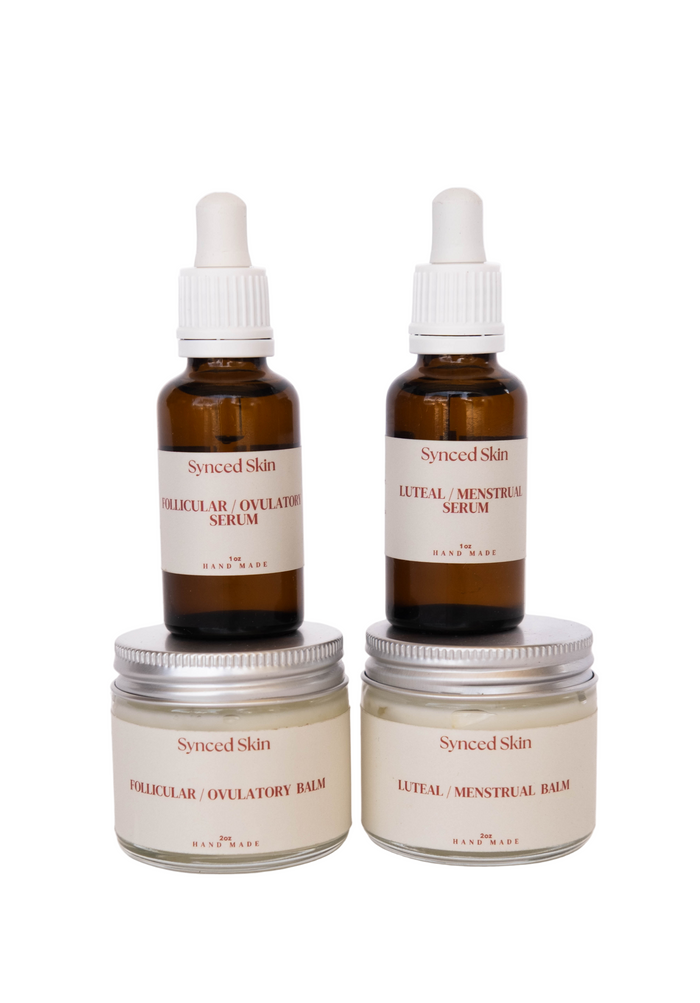
Each pairing includes a jojoba-based serum and matching tallow balm—two simple steps to support your skin through every phase.

Find your routine

After your period ends, use the Follicular + Ovulatory Serum and Balm through ovulation.

Then switch to the Luteal + Menstrual Serum and Balm for the rest of your cycle, including your luteal phase and period.

Every cycle is different, so your timing may look a little different.

  1. 01

    Follicular

    After your period, before ovulation.

    What’s happening

    An egg is maturing as your body prepares for ovulation. This is the post-period chapter of your Synced Skin ritual.

    Your skincare

    Follicular + Ovulatory

    After your period, your skin may start to feel a little oilier. We made this pairing for that shift: a jojoba-based serum followed by a matching tallow balm, with clary sage, lemon, and lemongrass for a fresh, citrus-herbal scent. Use it through ovulation to keep your skin feeling soft and comfortable.

  2. 02

    Ovulatory

    Around ovulation.

    What’s happening

    Ovulation is the release of an egg, marking the transition from the first part of your cycle to the next.

    Your skincare

    Follicular / Ovulatory

    Stay with the same serum and balm through ovulation. The fresh-feeling ritual continues, with two familiar steps.

  3. 03

    Luteal

    After ovulation, before your period.

    What’s happening

    After ovulation, your body prepares for a possible pregnancy. If pregnancy doesn’t occur, your period follows.

    Your skincare

    Luteal + Menstrual

    As you move through your luteal phase and period, your skin may feel more sensitive or prone to breakouts. We created this pairing for that shift: a jojoba-based serum and matching tallow balm with frankincense, spearmint, and eucalyptus for a cool, calming scent. Apply the serum first, then the balm, until your period ends.

  4. 04

    Menstrual

    During your period.

    What’s happening

    Your uterine lining sheds during your period, marking the start of a new cycle. A moment to return to the familiar.

    Your skincare

    Luteal + Menstrual

    During your period, continue with the Luteal + Menstrual pairing. Your skin may feel more sensitive at this time, so keep the routine simple: jojoba-based serum first, then the matching tallow balm. Frankincense, spearmint, and eucalyptus give it a fresh, grounding scent.

After your period, return to Follicular / Ovulatory.
Your cycle continues. So does your ritual.

Make it your ritual

Shop for your phase. Or the whole cycle.

Start with a serum and balm, or bring both pairings home.

Follicular / Ovulatory Serum Follicular / Ovulatory Balm

After your period, through ovulation

Follicular / Ovulatory

One jojoba-based serum + one matching tallow balm.

From $77.00 USD Serum + balm

Shop this pairing

Two individual products, added together. One-time purchase.

Luteal / Menstrual Serum Luteal / Menstrual Balm

After ovulation, through your period

Luteal / Menstrual

One jojoba-based serum + one matching tallow balm.

From $77.00 USD Serum + balm

Shop this pairing

Two individual products, added together. One-time purchase.

Starter Kit

The complete Starter Kit

Your whole cycle,
in one kit.

Two serums. Two balms. Both botanical pairings, ready for every chapter.

From $123.00 USD Mini or Full Size

Choose your Starter Kit

All four formulas. One simple place to start.

The same two steps

Two steps, every phase.

01 / Serum

Apply a few drops of your phase’s jojoba-based serum to clean, damp skin.

02 / Balm

Follow with a small amount of its matching tallow balm. Read your product’s directions and ingredient list before use.

See what’s inside

Luteal / Menstrual Balm

Tallow, jojoba oil, frankincense essential oil, spearmint essential oil, eucalyptus essential oil.

Research and limits

What the research can tell us.

Explore the research, sources and limitations

The menstrual cycle is a real hormonal rhythm, and skin experiences can change with it. But studies differ in what they find, and no single cycle calendar describes everyone’s skin.

In a survey of 400 women with acne, 44% reported a premenstrual flare. A small study that counted facial acne lesions also observed premenstrual increases in many participants. Separate studies have measured changes in irritant response and sebum composition, while another found no significant phase-related differences in its moisture, oil and pH measures.

These studies help explain the collection’s inspiration. They do not show that anyone needs to switch skincare on a fixed schedule, or that Synced Skin products treat acne or affect hormone levels. Acne has evidence-based treatments, and a dermatologist can help with persistent or painful breakouts. Choose skincare by ingredients, how your skin feels and the directions on your current label.

  1. 01

    Menstrual cycle physiology, NCBI Bookshelf. Background on follicular and luteal hormone changes.

  2. 02

    The effect of the menstrual cycle on acne, 2001. Survey of 400 women with acne; self-reported flares, not a product trial.

  3. 03

    Quantitative documentation of a premenstrual flare of facial acne, 2004. Small lesion-count study over two cycles.

  4. 04

    Relationship of cutaneous moisture, sebum and pH changes of healthy skin with menstrual cycle, 2020. A limited sample with no significant differences in its measured outcomes.

  5. 05

    Menstrual cycle and skin reactivity, 1991. An irritant patch-test study in 29 women, not a facial skincare-product trial.

  6. 06

    Physiological Differences in Sebum Composition in Regularly Menstruating Healthy Women, 2025. A small observational study of facial sebum lipids.

  7. 07

    Acne: Diagnosis and treatment, American Academy of Dermatology. An overview of evidence-based acne treatments and when to seek individualized care.

  8. 08

    Acne: Tips for managing, American Academy of Dermatology. Guidance on gentle skincare alongside acne treatment.

These sources provide context for the collection’s inspiration. They are not evidence of finished-product efficacy.

Explore the ingredient guide